
Farmer ID: The Complete Guide to Your 11-Digit Kisan Identity Number
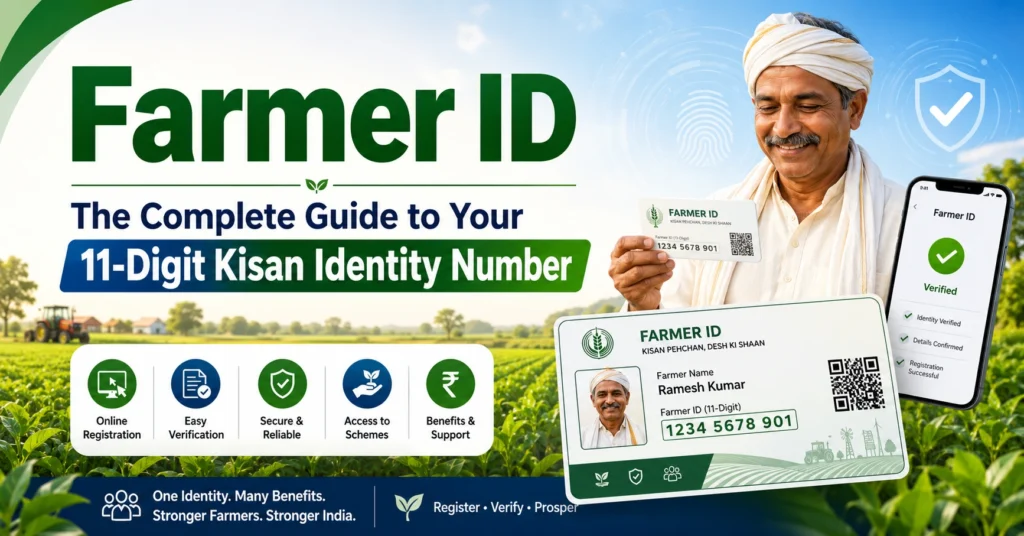
The Farmer ID is an 11-digit number that now works as a farmer’s permanent identity across every government system in Indian agriculture. Banks read it before approving crop loans. Procurement centres read it before buying your paddy. PM-Kisan reads it before releasing your installment. Insurance companies read it before settling a claim. One number, verified once, accepted everywhere.
This page is entirely about that number: what sits inside it, how departments use it, how to get yours, how to check or recover it when you lose the SMS, what you can do after logging in with it, who can see your data and who cannot, what happens to the ID when land changes hands or a farmer passes away, and the myths that stop people from taking it.
If you have not registered yet, our farmer registration guide walks the application screen by screen. This page assumes you either hold an ID or are deciding whether to get one, and answers everything around the number itself.
What exactly is the Farmer ID?
The Farmer ID (also written as Kisan ID, FID, or Farmer Registry ID) is a unique 11-digit number issued from the Farmers Registry, the core database of AgriStack, after a farmer’s identity and land are verified. The Government of India designed it as the agricultural equivalent of Aadhaar: a single lifetime number that any authorised system can check in seconds.
The comparison with Aadhaar helps because the two work as a pair, not as rivals. Aadhaar proves who you are as a person. The Farmer ID proves who you are as a farmer: that you cultivate land, which plots, how much area, in which villages. Aadhaar sits underneath the Farmer ID; you cannot get the second without the first, since registration runs on Aadhaar eKYC. But Aadhaar alone tells a bank nothing about your farm. The Farmer ID fills that gap.
A few properties of the number worth knowing:
- It is permanent. One farmer, one ID, for life. No renewal, no expiry, no yearly fee.
- It is individual, not family-based. Each person named in a land record gets their own ID, including women co-owners and each brother in a joint holding.
- It is state-issued on a national design. Your state generates the number through its registry portal, but the format and the system behind it are common across India, so the ID is readable by central schemes too.
- It is free. No government charge exists at any stage, for getting it, holding it or using it.
What information is linked to your Farmer ID
The number itself is just a key. What matters is the verified record it opens. Four layers of information hang on your ID.
Your identity layer
Name, photograph, date of birth and gender, all pulled from Aadhaar during eKYC, plus your Aadhaar-linked mobile number. Because this layer comes from Aadhaar rather than from a form you typed, departments treat it as verified truth. This is why a name mismatch between Aadhaar and land records gets caught during registration: the system compares this layer with the next one.
Your land layer
Every plot linked to you, with its khasra, gata or survey number, village, tehsil, district, your share in joint holdings, and the area. This layer stays connected to the state land record system, so when a mutation completes after you buy or sell land, the change flows into your ID’s record without a fresh registration. The land layer is what makes the ID valuable to banks and procurement centres: they no longer ask you for khatauni copies because the ID shows them the live record.
Your crop layer
Season by season, the digital crop survey records what stands on your plots, and those entries attach to your ID through the Crop Sown Registry. Your kharif paddy entry, your rabi wheat entry, the area under each: this layer decides how much a procurement centre may buy from you and what an insurance claim can cover.
Your scheme layer
As departments connect their systems, the schemes you receive link up: PM-Kisan beneficiary status, KCC linkage, subsidy applications, relief payments. Over time this layer becomes your benefit history in one place, which also lets systems catch duplicate and fake claims that plagued the old scattered lists.
How the Farmer ID works when someone checks it
Understanding the checking side removes the mystery from why offices ask for it.
When you give your Farmer ID at a bank branch, a procurement centre or a scheme counter, the official’s system queries the registry and gets back your verified details, but only the slice that department is authorised to see and only for a defined purpose. A bank processing your KCC sees your land holdings. A procurement portal sees your crop entries. The design runs on consent and purpose limitation: you consented to this sharing in the declaration you signed during registration, and departments cannot browse the registry freely for unrelated reasons.
The Farmer ID card adds a faster route: its QR code. An official scans the code with an authorised app and your verified record appears on their screen, photo included, so nobody needs to type numbers or trust a photocopy. This is why we advise keeping the printed card’s QR code unfolded and clean; a damaged code sends you back to the slow lane of manual entry.
One more quiet feature: because every check runs against the live registry, a forged or edited card fails instantly. The paper is not the proof; the record is. This has already started drying up the fake-beneficiary business that fed on photocopied documents.
How to get a Farmer ID: the short version
Getting the ID happens through farmer registration on your state’s portal. In brief:
- Open your state’s registry portal (upfr.agristack.gov.in for UP, mpfr for MP, gifr for Gujarat, mhfr for Maharashtra, and so on) or visit a CSC centre or village camp.
- Complete Aadhaar eKYC with OTP, or by fingerprint at a CSC if your Aadhaar mobile is broken.
- Fill the short form and add every land plot by its record number.
- Submit with a final OTP and save your enrollment ID.
- Wait for verification; the 11-digit ID arrives by SMS on approval, usually within days to a few weeks.
That is the skeleton. The complete walkthrough, including joint land, inherited land, name mismatches, CSC charges and every rejection fix, lives on our farmer registration page. Go there if you are yet to apply; the rest of this page serves you once the ID exists or is on its way.
Farmer ID check: how to find your ID if you lost it
The approval SMS carries your ID, and phones being phones, that SMS disappears. Losing the number costs nothing permanent; here are the recovery routes, fastest first.
Route 1: Search your SMS inbox. Before anything else, search your messages for “farmer”, “FID” or your state portal’s sender code. The original SMS survives more often than people think.
Route 2: Log in to your state portal. Your dashboard displays the ID on the first screen. Log in with your mobile number and the password you set; the forgot-password option works through an OTP to your Aadhaar-linked mobile if the password is gone too.
Route 3: The know-your-ID search on the portal. Most state portals offer a public check where you enter your Aadhaar number or enrollment ID and the system returns your Farmer ID and status. Look for links named “Check Enrollment Status”, “Know Your Farmer ID” or similar on the portal home page.
Route 4: A CSC operator or your krishi sahayak. With your Aadhaar, either of them can pull your record from their side of the system in a minute. This is also the route when your Aadhaar mobile is dead and OTP-based recovery cannot start.
Route 5: Your documents. If you ever downloaded the ID card PDF, the number is on it. Check your phone’s downloads folder, your DigiLocker, and the printout in your file.
Write the recovered number in two places on paper. The ID is not secret like a bank PIN (officials quote it openly on lists), so a written copy in your document file carries no risk and saves the next search.
Farmer ID login: entering your record
“Farmer ID login” confuses people because you do not actually log in with the 11-digit ID. Portals log you in with your registered mobile number plus password, or mobile plus OTP, and the ID is what you see after entering. If a website asks you to type your Farmer ID and an OTP to “log in,” check the address twice; official portals do not work that way, and fake sites use exactly that trick to phish numbers.
The genuine login sits on your state’s agristack.gov.in portal, the same place you registered. Kerala farmers log into AIMS, Odisha farmers into Krushak Odisha, Karnataka farmers into FRUITS. Bookmark yours once and reach it from the bookmark every time.
What you can do after logging in
The dashboard is more useful than most farmers realise. Depending on your state’s build, you can:
- View your complete record: identity, every linked plot with areas, and your crop entries where the state surfaces them.
- Download or reprint your Farmer ID card any number of times, free.
- Update your mobile number after changing your SIM (states differ; some route this through Aadhaar update first).
- Add a newly acquired plot once its mutation completes, or flag a plot that should no longer show against you after a sale.
- Track applications and modifications you have filed, with their status.
- See scheme linkages where the state shows PM-Kisan or DBT connections against your record.
A good habit: log in once after every season and after any land event, scan the record for surprises, and log out. Farmers who never look at their record discover errors only when a payment fails.
Farmer ID and the Farmer ID card: number versus paper
The ID is the number in the registry. The card is a printable PDF that carries the number, your photo and the QR code. You will use the number when filling forms and quoting over the phone; you will show the card at counters and camps. Losing the card means printing it again, nothing more; losing the number means the five recovery routes above. The card never expires because it is only a window to the live record.
We keep a separate detailed guide on the card itself, covering download steps for every state, what each element on the card means, reprinting, and what to do when the download button fails. If your card question is not answered in one line here, that page has it.
Where the Farmer ID gets used: a walk through the year
The homepage of this site lists benefits scheme by scheme. Here, look at the same reality the way a farmer meets it across a year, because that is how the ID actually enters your life.
At the bank in April. You want a KCC top-up before kharif sowing. The branch keys your Farmer ID, your plots and areas appear from the registry, and the file that once waited on a patwari’s verification letter moves the same week.
At sowing in June and July. The crop survey team records paddy on your plots against your ID. You confirm the entry with your krishi sahayak because you know the procurement centre will read this very entry in November.
When the installment lands in August. PM-Kisan’s payment file checks your ID linking and your Aadhaar-seeded account, and Rs 2,000 arrives without you filling anything.
At the mandi in November. Token booking for paddy sale runs on your ID; the centre’s screen shows your surveyed paddy area, and your sale limit follows from it.
After the hailstorm in February. The relief list for your village is drawn from the registry and the rabi crop entries. Your compensation reaches your account without an application, because the system already knows whose wheat stood on which plot.
At the dealer in March. A subsidised seed or fertiliser scheme asks for your ID at the point of sale, checks eligibility in seconds, and applies the subsidy on the spot instead of sending you through an application season.
Not every state has wired every one of these yet, but each is live somewhere in the country and the direction is one-way. The ID starts as a registration chore and ends up as the thing that quietly moves your money all year.
Farmer ID versus every other number in agriculture
Farmers today juggle half a dozen numbers, and offices rarely explain which is which. This table settles it once.
| Number | Digits | Identifies | Issued by | Do you need it? |
|---|---|---|---|---|
| Farmer ID | 11 | You, as a farmer | State registry (AgriStack) | Yes, for nearly everything now |
| Aadhaar | 12 | You, as a person | UIDAI | Yes, it sits under the Farmer ID |
| ULPIN / Bhu Aadhaar | 14 | One land plot | Land records dept | Automatic; attaches to plots, not to you |
| PM-Kisan registration no. | Varies | Your scheme enrollment | PM-Kisan portal | Only inside PM-Kisan |
| Enrollment ID | Varies | Your registry application | State portal at submission | Only until approval |
| KCC number | Bank format | Your credit line | Your bank | Only if you hold the card |
| Old state IDs (UP panjikaran, Bihar DBT 13-digit, FRUITS FID) | Varies | Legacy state records | Old state portals | FRUITS FID still counts in Karnataka; the rest are legacy |
Two habits follow from this table. Quote the 11-digit Farmer ID whenever an office says “farmer number” without specifying, because that is almost always what their system wants. And never assume a number transfers between systems; the enrollment ID means nothing at a bank, and a KCC number means nothing at a procurement centre.
Verifying a Farmer ID: for dealers, banks, buyers and landlords
A growing group of readers comes at this from the other side: an input dealer applying a point-of-sale subsidy, a bank officer processing a loan file, a rice mill buying paddy, or a landowner checking a prospective tenant’s claim. Here is how verification works from the checking side.
The authorised route is the QR code on the Farmer ID card, scanned through the department or partner app your role gives you access to. The scan returns the live registry record: photo, name, ID and the data slice your purpose permits. A record that fails to resolve, or resolves to a different photo, ends the conversation; the paper in front of you is not the proof, the registry response is.
What checkers should not do also matters. There is no public lookup where anyone can type an 11-digit number and browse a stranger’s land holdings; access rides on authorisation and purpose, which protects farmers from data fishing by marketers, rivals in a land dispute, or lenders you never approached. If your business genuinely needs verification access, the route is enrolment with the relevant department or its API partner programme, not asking farmers for portal passwords. And any professional asking a farmer to hand over portal login credentials should be refused; the QR scan exists precisely so nobody needs the farmer’s account.
For farmers, the flip side is reassuring and worth repeating: showing your card and letting the QR be scanned reveals only the purposeful slice, and refusing to share your OTP or password blocks everything else.
Problems specific to ID holders, and their fixes
The registration page on this site handles application-stage failures. Different problems appear after the ID exists. The frequent ones:
Approval SMS came but the ID does not appear anywhere. Give the systems a day to sync, then log in to your dashboard rather than the public search; dashboards update first. Still blank after two or three days: your krishi sahayak can check whether the ID generated with a record flag that needs one more approval touch.
The card shows a wrong photo or an odd name spelling. The identity layer mirrors Aadhaar, so the error lives in Aadhaar. Update Aadhaar (photo updates are done in person at any centre) and the record refreshes at the next sync or eKYC. Do not file registry corrections for Aadhaar-borne errors; they bounce.
A plot on my record is not mine. Rare but serious: a selection error at registration, yours or an operator’s, attached a neighbour’s khasra. File a modification to delink it now, before any season’s crop survey builds entries on top of the mistake. Officials treat voluntary correction gently; discovered wrong claims during a procurement audit go harder.
A plot of mine sits on someone else’s ID. The mirror problem, usually surfacing when your own plot addition fails with an already-linked message. Take your khatauni to the block agriculture office; verification against the land record resolves ownership, and the wrong linkage is removed.
Two IDs against one person. Occasionally an early registration and a camp registration both matured. The system or the officer closes one, keeping the record with the fuller land linkage. Report it yourself when noticed; a self-reported duplicate closes cleanly, while a discovered one can freeze both records during checking.
Dashboard shows fewer plots than I hold. The missing plot’s mutation may still be pending, its village records may not be digitised, or it was simply never added. Diagnose in that order: check the mutation status at the tehsil, check whether the village appears in the portal dropdown, then add the plot through the dashboard.
None of these problems threatens the ID itself. The number stays; the record around it gets repaired. The only real damage in every case above comes from waiting a season before acting.
What the Farmer ID is called in different states
The national design travels under local names, and knowing your state’s word saves confusion at offices.
In Karnataka, the FRUITS system issues an FID, and officials say “FRUITS ID” or just “FID”; it serves as the Farmer ID there. In Odisha, your Krushak Odisha registration carries the farmer identity, and staff say “Krushak Odisha ID”. Telangana officials speak of farmer registration through the Rythu ecosystem alongside Bhu Aadhaar numbers for land parcels. UP and the Hindi belt say “Farmer Registry” and “kisan ID” interchangeably. Andhra Pradesh farmers hear it at the RBK as part of e-crop and Annadata records.
Two terms deserve care because they are not the Farmer ID. “Bhu Aadhaar” or ULPIN is a 14-digit number for a land parcel, an ID for the plot rather than the person; your Farmer ID links to plots that may carry ULPINs, but the two are different numbers for different things. And the “PM-Kisan registration number” is a scheme enrollment reference, not the registry ID. When an office asks for your Farmer ID, they want the 11-digit number from your state’s agristack registration, whatever local name travels with it.
Updating the record behind your ID
The number never changes; the record behind it should, whenever life changes. Here is what updates and how.
Mobile number. Update Aadhaar first at an Aadhaar Seva Kendra, then update the portal record or let the next eKYC refresh it. Do this the same month you change SIMs; every OTP and alert rides on it.
Land after purchase or inheritance. Complete mutation at the tehsil; the plot then appears against your ID through the land record link, or you add it from the dashboard where your state provides the option.
Land after sale. The buyer’s mutation removes the plot from your record. Check your dashboard a few weeks after any sale registers, and raise a correction if a sold plot still shows, because ghost plots distort your scheme eligibility.
Name, category or date of birth. Identity fields follow Aadhaar; fix Aadhaar and the correction flows in at the next verification. Category changes go through the portal’s modification option with the certificate.
Bank account. DBT payments follow your Aadhaar-seeded bank account rather than a number typed in the registry, so account changes happen at your bank by re-seeding Aadhaar, not on the portal.
Every update leaves the 11-digit ID untouched. You never re-register, and anyone advising a “fresh ID” to fix a record error is wrong; the system permits one ID per Aadhaar for life.
Privacy, consent and who can see your data
Farmers ask two fair questions: who can look at my record, and can this data hurt me? The honest answers:
Authorised government departments and their systems see your data for defined purposes: scheme delivery, procurement, credit verification, relief. The consent you signed at registration covers this sharing. Private entities like banks and insurance companies access records through regulated channels for services you apply for; a bank checks your land because you asked it for a loan, not because it can browse farmers at will.
Your data is protected by the same framework that governs other government digital systems, including India’s data protection law. What the registry cannot do is as important as what it can: it cannot change your land record, cannot create a tax, cannot transfer ownership, and cannot be used by a private company to market to you without consent flowing through proper channels.
Your side of data safety is simpler and matters more day to day: never share OTPs on phone calls, never type your Aadhaar and OTP on websites that do not end in gov.in, and treat anyone who calls “from AgriStack” asking to verify your account as a fraudster, because no such calls exist. The number itself is not a secret; the OTP always is.
When a farmer passes away
A question families face and offices explain poorly. The Farmer ID is individual and does not transfer. When the recorded farmer dies, the heirs complete mutation of the land, after which each heir registers (or updates their existing registration) so the plots appear against their own IDs. The deceased’s ID is closed in the registry once records update.
Practical order for families: obtain the death certificate, file for mutation with legal heir documents, and once the record shows the heirs, register each heir who now holds land. Pending payments to the deceased’s account follow the state’s succession process for that scheme. During camps, staff handle these cases at one table, which is far easier than sequencing it across offices; ask the krishi sahayak to flag the case at the next drive.
Myths about the Farmer ID, answered plainly
“The ID will bring tax on farm income or land.” No. The registry reads records; it has no taxing power, and no state has taxed anyone through it. The rumour survives because it excuses inaction.
“Registering means the government can take my land.” Ownership lives in the land record system, untouched by registration. The registry cannot acquire, transfer or encumber anything.
“One ID for the family head is enough.” Each landholder should hold their own ID. A single-ID family leaves the other co-owners invisible to schemes, including women whose names are on the record.
“My old state registration or PM-Kisan number does the same job.” It does not; those are different databases, and the systems now checking IDs check this one.
“Getting the ID guarantees benefits.” The ID is the gate, not the grant. Scheme rules still apply; the ID just stops paperwork from being the reason you miss out.
“If I stay out, nothing changes.” Payments and procurement are being wired to the ID one by one. Staying out increasingly means opting out of the money.
Frequently asked questions
What is the Farmer ID in simple words?
It is an 11-digit number that works as a farmer’s permanent government identity, linked to Aadhaar and to every land plot the farmer holds. Departments check the number to verify a farmer in seconds, which is why PM-Kisan, banks, procurement centres and subsidy portals all ask for it now.
How do I check my Farmer ID by Aadhaar number?
Open your state’s registry portal and use the “Know Your Farmer ID” or enrollment status search, enter your Aadhaar number, and the system returns your ID and status. If the portal insists on an enrollment ID you no longer have, a CSC operator or krishi sahayak can pull your record from your Aadhaar in a minute.
Is Farmer ID and Kisan ID the same?
Yes. Kisan ID, FID, Farmer Registry ID and Farmer ID all mean the same 11-digit number from the AgriStack Farmers Registry. Karnataka’s FRUITS ID serves the same role there. The only lookalikes to avoid confusing are the Kisan Credit Card (a bank loan product) and the PM-Kisan registration number (a scheme reference).
How many digits is the Farmer ID?
Eleven digits, issued by your state’s registry on the common national design. If a number you hold has a different length, it is probably a different reference: Bihar’s old DBT number ran 13 digits, ULPIN (Bhu Aadhaar for a plot) runs 14, and enrollment IDs from the application stage vary by state.
Can I get a Farmer ID without land?
In most states, not yet, because the registry verifies farmers through land records. Tenant farmers and sharecroppers can register where their state has opened that route with cultivation certificates; Odisha covers sharecroppers most fully. Landless labourers are outside the registry for now. Our registration page tracks which states accept tenants.
Does the Farmer ID expire or need renewal?
Never. The ID is issued once and lasts for life. What needs attention is the record behind it: seasonal crop entries, mobile number updates, and land changes after mutations. The number itself stays constant through all of it.
I have land in two states. Do I get two Farmer IDs?
Registrations are state-wise, so a farmer holding agricultural land in two states registers in each state’s portal for that state’s land. Within one state, all districts’ plots sit under a single ID. Genuine two-state holdings are the one situation where a person can hold two registry records, each covering its own state’s land.
Someone is asking for my Farmer ID and OTP on a phone call. Is it genuine?
No. The ID itself is not secret and quoting it is harmless, but no genuine official ever asks for an OTP on a call, ever. The OTP on your phone belongs only in the official gov.in portal open in front of you. An OTP given on a call is your record handed to a fraudster.
Can I use the Farmer ID as address or identity proof outside agriculture?
No. It is an agricultural identity for scheme, credit and procurement systems, not a general KYC document like Aadhaar, passport or voter ID. A bank will happily read it for your crop loan and still ask for standard KYC documents to open the account.
How do I remove a plot from my Farmer ID after selling it?
The buyer’s mutation normally drops the plot from your record automatically. Check your portal dashboard a few weeks after the sale deed registers; if the plot still shows, file a modification through the portal or at the agriculture office with the sale details. Clearing sold plots matters because area-based benefits read your recorded holding.
My Farmer ID exists but PM-Kisan says not linked. What is missing?
The linking is completed on the PM-Kisan side, not the registry side. Finish eKYC at pmkisan.gov.in or a CSC, confirm your bank account is Aadhaar-seeded at the branch, and check your beneficiary status shows the Farmer ID. All three pieces must be in place before installments flow.
Is there any card or certificate along with the number?
Yes, the Farmer ID card, a PDF you download free from your portal dashboard, carrying your photo, the 11-digit number and a QR code that officials scan for instant verification. Print it, keep it with your documents, and reprint any time; the card has no expiry. Our separate card guide covers download steps for every state.
What is the difference between Farmer ID and Bhu Aadhaar (ULPIN)?
The Farmer ID identifies a person; Bhu Aadhaar identifies a plot. ULPIN is a 14-digit number assigned to each land parcel in the digitised record. Your one Farmer ID links to several plots, each of which may carry its own ULPIN. Offices dealing with land measurement talk ULPIN; offices dealing with farmers talk Farmer ID.
Can my Farmer ID be cancelled or blocked?
Records are closed on death and corrected when fraud or wrong linkage is found, and a plot wrongly attached to someone can be delinked after verification. For an ordinary farmer with a genuine record, there is no cancellation risk, no fee to keep the ID alive, and no action needed except keeping the record accurate.
Disclaimer: agristack.com.in/ is a private informational website with no connection to the Government of India or any state government. Farmer IDs are issued only through official portals ending in gov.in. Rules differ by state and change over time; confirm the current position on your state’s official portal or at your local agriculture office before acting.