
Telangana Farmer Registration: Complete Guide to the Farmer Registry, Rythu Bharosa and Status Checks
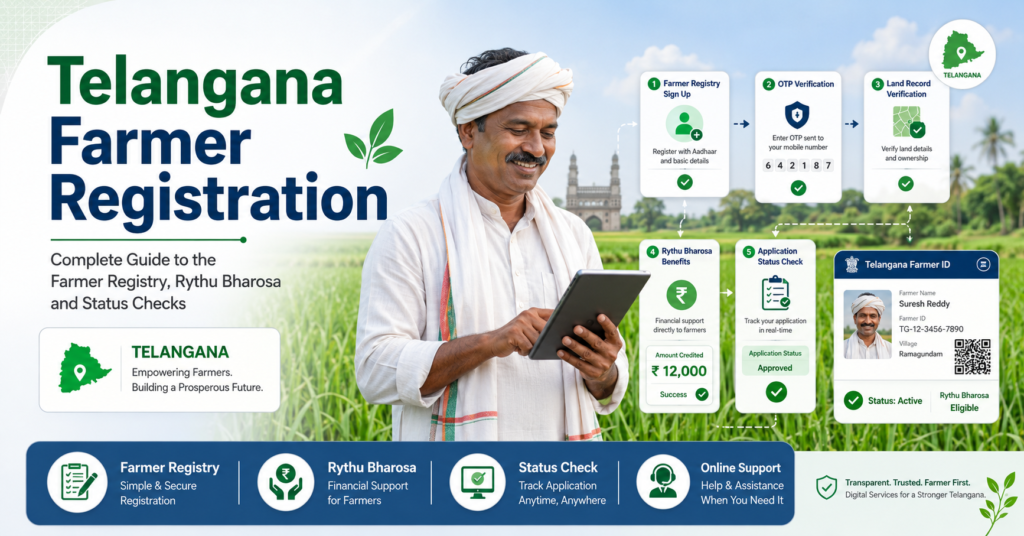
Telangana pays farmers per acre, which changes everything about how registration works here. Rythu Bharosa’s investment support flows to every recorded acre each season, so the state’s farmer records, the pattadar passbooks, the pahani entries, and now the AgriStack farmer registry, are not background paperwork but the direct arithmetic of what lands in your account. This page is the complete Telangana manual: how the farmer registry works alongside the land records system, registration through the AEO network, Rythu Bharosa payment status, crop booking and paddy procurement, and the fixes for the record gaps that cost Telangana farmers real money per acre per season.
The national AgriStack background lives on our overview page, and the generic application logic on the farmer registration guide; this page keeps to Telangana’s own systems and vocabulary.
State-wise official AgriStack farmer registry portals
Every button opens the official government website of that state. Registration is free on all of them.
| State | Official portal |
|---|---|
| Uttar PradeshUP Farmer Registry (UPFR) | Open UPFR Portal |
| MaharashtraMaharashtra Farmer Registry (MHFR) | Open MHFR Portal |
| Madhya PradeshMP Farmer Registry (MPFR) | Open MPFR Portal |
| GujaratGujarat Farmer Registry (GIFR) | Open GIFR Portal |
| RajasthanRajasthan Farmer Registry (RJFR) | Open RJFR Portal |
| BiharBihar Farmer Registry (BHFR) | Open BHFR Portal |
| OdishaKrushak Odisha | Open Krushak Odisha |
| TelanganaTelangana Farmer Registry | Open TGFR Portal |
| Andhra PradeshAP Farmer Registry (APFR) | Open APFR Portal |
| AssamAssam Farmer Registry | Open Assam Portal |
| KeralaAIMS Kerala | Open AIMS Kerala |
| Tamil NaduTN Farmer Registry (TNFR) | Open TNFR Portal |
| KarnatakaFRUITS Portal | Open FRUITS Portal |
| West BengalWB Farmer Registry (WBFR) | Open WBFR Portal |
| All other states & UTsNational AgriStack portal | Open AgriStack India |
How farmer registration works in Telangana
Telangana’s farmer identity has always run closer to the land record than most states. The pattadar passbook, issued against your recorded holding, has been the farmer’s operative document for years, and the state’s land records platform (the Dharani system, whose functions the state has been moving into the successor Bhu Bharati framework) holds the pahani entries behind it. The AgriStack farmer registry (TGFR) builds on this base: registration verifies you against the recorded holding and issues the 11-digit Farmer ID that central systems read, aligned with the state records that Telangana’s own schemes read.
The practical route differs from self-serve states. Telangana works through its Agriculture Extension Officer (AEO) network, with each cluster’s AEO knowing the village’s farmers, running enrollments and verifications, and anchoring the crop booking each season, often from the Rythu Vedika platforms built as farmer meeting points. A Telangana farmer’s first move on any registration question is the AEO, and most registrations complete through that assisted route or through the drives the department runs, with CSC support filling gaps. The self-registration principles from our registration guide still apply, Aadhaar eKYC, linked mobile, exact record details, but expect the AEO to be the hands on the keyboard more often than in UP or Gujarat.
What you need: Aadhaar with a working linked mobile, your pattadar passbook number, and your pahani details, survey numbers and extents, current, because the per-acre arithmetic reads them. Joint pattas follow the national rule: your name, your share, never the whole joint holding.
Rythu Bharosa: the per-acre payment and its status
Rythu Bharosa is Telangana’s flagship investment support, paying per acre per season to recorded cultivators, the successor to Rythu Bandhu with revised terms under the current government. Because payment multiplies acres, the record is the money: an acre missing from your recorded holding is support missing from your account every season until fixed, which is why Telangana farmers check records with an intensity other states reserve for exam results.
Checking payment status. Rythu Bharosa status runs on the scheme’s portal by pattadar passbook number or Aadhaar, showing season-wise credits. Missed or short payments trace to a short list: a holding change not yet in the record, a pattadar passbook issue, bank account seeding problems, or eligibility screening under the current norms. The fix path starts at the AEO and the tahsildar for record-side causes, and at the bank for seeding.
The registry connection. As the Farmer ID linkage deepens, the same verified identity threads Rythu Bharosa, PM-Kisan’s central installments (whose eKYC and seeding trio our Farmer ID guide covers) and the procurement systems, one record feeding all three instead of parallel lists drifting apart.
Crop booking: Telangana’s digital crop survey
Telangana records every season’s crop plot-wise through crop booking, the AEO-anchored digital survey that predates the national programme and folded into it. The AEO records the crop on each survey number, and the entries drive the season’s economics: paddy procurement quantities, insurance where applicable, and the input support calculations.
The farmer’s job is presence and verification: be reachable at booking time, confirm the crop entered for every survey number matches the field, and push corrections through the AEO inside the season, because a wrong entry surfaces months later at the procurement centre where nobody can fix it. Fallow and non-agricultural entries against land you actually cultivated are the expensive mistakes; they subtract acres from every downstream calculation.
Paddy procurement and the record chain
Telangana’s paddy procurement moves enormous volumes through the civil supplies machinery each season, and the purchase at your centre reads the chain built above: your recorded holding, your crop booking entry for paddy, and your registered identity. Token and slot flows at the centres run on that arithmetic, and the bonus structures for fine varieties sharpen the stakes.
The season rule matches the national logic with Telangana’s per-acre twist: records current before sowing, crop booking verified after sowing, and the procurement window entered with both green. A farmer whose booking shows less paddy than the field grew sells the difference into the open market at whatever price it brings; the record decides which price you get.
Other Telangana systems worth knowing
Rythu Bima, the state’s farmer life insurance riding on the same records, keeps enrollment aligned with the recorded farmer base. TSMIP (the micro irrigation project, whose farmer portal and status checks draw steady searches) runs drip and sprinkler subsidies through its own application flow, aligning to registry identity over time. OLMS handles agri-marketing licences, a dealer-side system farmers meet indirectly. IGRS Telangana (registration and stamps) is where land transactions record, feeding the record chain everything else reads, and the mutation delay between a sale deed there and the updated pahani is the gap where payments go missing. Legacy department portals and old registration records follow the national legacy rule from our UP page: useful history, not the current registry.
Regional notes across Telangana
The paddy belts (Nalgonda, Suryapet, Nizamabad, Karimnagar sides) live the full chain every season: booking, token, procurement, and the per-acre support on top, making record hygiene the local economy. Southern districts with lighter irrigation see cotton and pulses where crop booking accuracy drives insurance more than procurement. The Hyderabad periphery carries conversion pressure: land moving out of agriculture mid-record produces booking disputes and eligibility screening cases, best untangled at the tahsildar before the season. Tribal and forest-fringe villages completed record digitisation last, with the familiar missing-village and khata-gap routes running through the tahsildar and the AEO.
The Telangana system map: every portal and office explained
The farmer registry (TGFR under AgriStack) creates the national Farmer ID on the base of your recorded holding, reached most practically through your AEO and the department’s drives.
The Rythu Bharosa portal shows the per-acre payment status by pattadar passbook number or Aadhaar, season by season.
The land records platform (the Dharani system, with functions moving into the Bhu Bharati framework) holds the pahani and pattadar records everything reads; the tahsildar’s office is where record corrections and mutations actually happen.
IGRS Telangana records land transactions, the upstream event whose mutation lag produces most missing-payment cases.
Crop booking is the AEO-recorded seasonal survey feeding procurement, insurance and support calculations.
The civil supplies procurement system turns bookings into paddy tokens and payments each season.
TSMIP runs micro-irrigation subsidies, OLMS the marketing licences, and pmkisan.gov.in the central installments alongside the state support.
The Telangana working order: record verified at the tahsildar after any land event, registry and passbook aligned through the AEO, crop booking confirmed every season, then tokens, procurement and both payment streams follow. The AEO and the tahsildar are the two humans who solve what portals cannot; know both.
Fixing Telangana-specific problems
Acres missing from Rythu Bharosa payment. Compare the payment’s acreage against your pahani; the gap is the diagnosis. Record-side causes go to the tahsildar (mutation pending, extent error), account-side to the bank, and eligibility screening questions to the AEO with your documents.
Pattadar passbook issues. Corrections and reissue run through the land records system; the passbook number threads every scheme, so fix passbook problems before chasing scheme-side symptoms.
Sale registered but pahani unchanged. The IGRS-to-record lag. Follow the mutation through the tahsildar; until the record moves, payments follow the old holder and procurement reads the old picture.
Crop booking shows the wrong crop or fallow. Push correction through the AEO inside the season’s window, with the field as evidence; after the window, corrections climb approval ladders while the season’s money passes by.
Joint patta, one brother receiving everything. The recorded shares decide; register and record each holder’s share so each receives directly, the joint-holding discipline our registration guide describes nationally.
Frequently asked questions: Telangana farmer registration
How do I register as a farmer in Telangana?
Through the AgriStack farmer registry built on your recorded holding, most practically via your cluster’s AEO or the department’s drives, with Aadhaar eKYC and your pattadar passbook and pahani details. The AEO network anchors registration, crop booking and corrections across Telangana.
How do I check my Rythu Bharosa payment status?
On the scheme portal by pattadar passbook number or Aadhaar, showing season-wise credits. Short or missing payments trace to record gaps, passbook issues, bank seeding or eligibility screening; diagnose by comparing paid acres against your pahani, then fix the failing link.
Is the pattadar passbook the same as the Farmer ID?
No. The passbook is Telangana’s land-record document against your holding; the Farmer ID is the national 11-digit registry identity. They connect through the same recorded holding, and Telangana farmers increasingly hold both, the passbook for state systems and the ID for central ones.
What is crop booking and why does it matter?
It is Telangana’s plot-wise digital crop survey, recorded by AEOs each season. Procurement quantities, insurance and support calculations read it, so verify the entry for every survey number after sowing and correct errors inside the season through your AEO.
Why is my paddy token quantity less than my harvest?
The token reads your crop booking and recorded extent, not your trailer. A booking that missed acres or recorded a different crop caps your procurement quantity; the excess sells outside the system. Fix bookings in-season, not at the centre.
My land purchase is registered but payments still go to the seller. Why?
The mutation has not entered the record yet; schemes pay the recorded holder. Follow the mutation through the tahsildar after the IGRS registration, confirm the pahani moved, and the next season’s payments follow you.
Does PM-Kisan work separately from Rythu Bharosa?
Yes, both flow to eligible farmers: PM-Kisan’s central installments with their eKYC, seeding and Farmer ID linking requirements, and Rythu Bharosa’s per-acre state support on the recorded holding. One clean record base serves both.
Can tenant farmers get Rythu Bharosa or register in Telangana?
The per-acre support follows the recorded holder, which has kept tenants largely outside it, a long-running Telangana debate. Registry coverage for tenants follows the state’s evolving rules; ask your AEO what currently applies, and see our registration guide’s tenant section for the national picture.
Disclaimer: agristack.com.in/ is a private informational website with no connection to the Government of India or the Government of Telangana. Registration happens only on official gov.in portals. Scheme terms change; confirm the current position with your AEO or on official portals before acting.