
UP Farmer Registry (UPFR): Complete Guide to Farmer ID Registration in Uttar Pradesh
Uttar Pradesh runs the largest farmer registry in India. The state has more farmers than any other, more PM-Kisan beneficiaries than any other, and its registry portal, upfr.agristack.gov.in, has processed more Farmer ID registrations than any other state portal in the country. If you farm in UP, this page is your complete manual: how UPFR works, how to register with your gata number, how the old upagriculture.com panjikaran relates to the new registry, how to check your status and download your card, which UP schemes now demand the Farmer ID, and how to fix the problems that stall applications in UP tehsils every day.
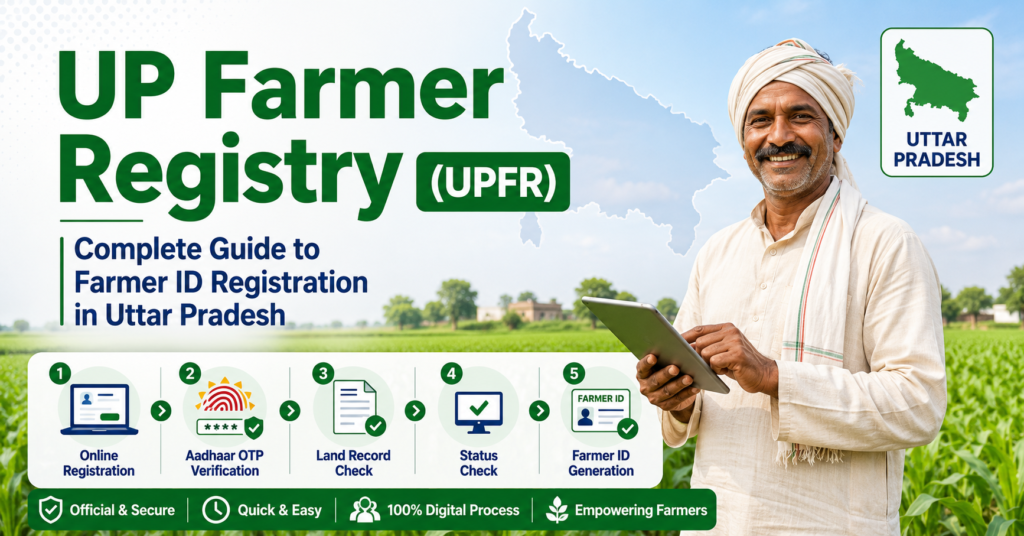
Everything here is specific to Uttar Pradesh. For the national picture of AgriStack, start from our AgriStack overview; for the general application walkthrough, use the farmer registration guide; and other states’ portals are covered in their own pages across this site. Here we stay inside UP: its portals, its land records, its lekhpals, and its deadlines.
What is UPFR? The UP Farmer Registry explained
UPFR stands for Uttar Pradesh Farmer Registry, the state’s implementation of the AgriStack Farmers Registry, running at upfr.agristack.gov.in. Every UP farmer who registers here receives the 11-digit Farmer ID after verification against the state’s land records.
UP moved early and hard on this. The state government tied Farmer ID linking to PM-Kisan continuation, ran registration camps in practically every tehsil, and put lekhpals and krishi sahayaks into the drive together, because UP understood one thing clearly: with more than two crore PM-Kisan beneficiaries, any payment stoppage for unlinked farmers would hit UP hardest. That push is why UP leads the national registration count, and also why UP’s verification queues run long in some districts; volume cuts both ways.
The registry connects with the systems UP farmers already touch: the bhulekh land records portal that holds your khatauni, the e-uparjan portal where wheat and paddy procurement runs, PM-Kisan’s beneficiary database, and the agriculture department’s subsidy systems. Your Farmer ID is becoming the thread through all of them.
UPFR and upagriculture.com: old panjikaran versus new registry
No UP farmer question comes up more often than this one, so let us settle it first.
For years, UP farmers registered on upagriculture.com (the UP Agriculture departmental portal, also reached as upagriculture.com 81 through its old server address). That kisan panjikaran gave you a registration number used for seed and machinery subsidies, solar pump applications and DBT benefits. Farmers printed their panjikaran (kisan panjikaran print) and generated tokens on the portal for subsidy claims and procurement (the token generate function many still search for).
Here is the position now: the old panjikaran is not the Farmer ID, and it does not convert automatically. The upagriculture registration lives in the agriculture department’s own database. The Farmer ID lives in the AgriStack registry at upfr.agristack.gov.in, built on Aadhaar eKYC and live land record linkage, which the old portal never had. Every UP farmer, including those with years-old panjikaran and a drawer full of token printouts, must complete the new UPFR registration separately.
What happens to the old portal? It continues for the departmental functions that still run on it, and the department is aligning its schemes to read the Farmer ID over time. Practical rule for a UP farmer in 2026: keep your old panjikaran details safe for any legacy scheme that asks, and treat the UPFR Farmer ID as the identity everything is moving to. When both exist, you are covered from both sides.
Before you register: UP documents and the gata number
UP registration follows the national pattern with UP-specific paperwork. Gather these first.
1. Aadhaar with a working linked mobile. Same as everywhere: three OTPs arrive during registration, all to the Aadhaar-linked number. Broken linking is fixed only at an Aadhaar Seva Kendra, and the fingerprint route at a Jan Seva Kendra (CSC) bypasses OTPs entirely if updating is delayed, as our registration guide explains in its biometric section.
2. Your khatauni with gata numbers. UP identifies plots by gata number (the survey/khasra equivalent) recorded in the khatauni. Pull a fresh khatauni from the UP bhulekh portal (upbhulekh.gov.in) by selecting your district, tehsil and village and searching by name or gata; the free online copy shows current entries including recent mutations. Fresh matters: an old khatauni copy that predates your varasat entry will mislead you at the land selection screen.
3. Bank passbook and, if wanted, caste certificate. The passbook is for cross-checking your DBT account; the certificate only if you choose to record category.
One UP-specific check before starting: open your khatauni and read the exact spelling of your name in Devanagari and the gata numbers of every plot, including tiny scattered ones. UP holdings fragment across gatas more than almost anywhere, and the commonest UP registration defect is registering three gatas of a seven-gata holding.
How to register on upfr.agristack.gov.in: step by step for UP
Step 1: Open the portal. Type upfr.agristack.gov.in yourself in the browser. Check the address ends with agristack.gov.in. UP’s size makes it the top target for lookalike fraud sites, and ads sometimes sit above the real result in searches.
Step 2: Choose Farmer and create your account. Select the Farmer option, click create new account, enter Aadhaar, tick consent, and enter the OTP from your Aadhaar-linked mobile. Your Aadhaar details appear; set a password and note it down.
Step 3: Log in and fill the form. Log in with your mobile number and password. Select your farmer type and category. Confirm your address maps to the correct district and revenue village; UP has villages with identical names in the same tehsil, distinguished only by the revenue village code, so match against your khatauni’s village entry, not the postal name.
Step 4: Add every gata. Select district, tehsil and village, then search each gata number from your khatauni. The portal displays the khatauni entry with all recorded holders. Find your own name, select it, confirm your share and area, and add. Repeat for every gata in every village where you hold land; all attach to one application. Joint khatauni entries are normal in UP: select only your own name against your share, never the whole gata when brothers and cousins share it.
Step 5: Review and submit. Read the summary against your khatauni line by line, tick the declaration, confirm with the final OTP, and save the enrollment ID from the screen and the SMS.
Step 6: Verification. Your application goes to the krishi vibhag side (krishi sahayak or agriculture supervisor) and the rajasva side (lekhpal) for matching against the record. UP districts vary widely here: some clear applications inside a week, loaded tehsils take three to four weeks, and drive periods slow everything as lakhs apply at once. The approval SMS carries your 11-digit Farmer ID.
Registering through Jan Seva Kendra or camps in UP
UP’s CSC network (Jan Seva Kendras) is the deepest in the country, and roughly half of UP registrations flow through it. Carry Aadhaar, the linked phone, and your khatauni; the operator completes the same steps, or uses fingerprint eKYC when your OTP route is broken. The notified service charge in UP is small, in the tens of rupees; collect the acknowledgement print with your enrollment ID and confirm your own mobile number went into the form.
UP has also run some of the largest registration camps anywhere, village-level shivirs where the lekhpal sits at the same table. If your case involves a khatauni error, a pending varasat or a name mismatch, the camp is worth waiting a week for, because the one official who can check the record question is present. Ask your lekhpal or krishi sahayak for the next camp date; blocks run mop-up rounds for villages already covered.
UPFR login, status check and Farmer ID download
Login. upfr.agristack.gov.in, Farmer option, your mobile number and password (or OTP login where offered). Forgot password works through the Aadhaar-linked mobile. If a Jan Seva Kendra registered you and you never had the password, the same reset route works, provided your own number was entered in the form; if the operator’s number went in, get it corrected at the Kendra or agriculture office first.
Status check. The portal’s enrollment status search (explained status-by-status in our status check guide) takes your enrollment ID or Aadhaar number without login and returns pending, approved, returned or rejected with remarks. UP also surfaces village-wise dashboards used during drives; your krishi sahayak can tell you where your application sits in the queue if the public status stays pending beyond a month. Escalation in UP runs through the block agriculture office (vikas khand), carrying your enrollment slip.
Card download. After approval, log in, open your dashboard, and use the download or print option for the PDF card carrying your photo, the 11-digit ID and the QR code. Print one copy for your file. UP procurement centres and banks have started asking for exactly this card, so do the five-minute download before the season you need it.
Which UP schemes and systems now use the Farmer ID
The reason UP pushed registration so hard is the list of systems reading the ID. Where it stands:
PM-Kisan. UP holds the country’s largest beneficiary base, and Farmer ID linking plus eKYC plus Aadhaar-seeded bank account is the trio every UP beneficiary must complete. Unlinked farmers in UP have seen installments held during linking drives. If your installment paused, this is the first place to look.
Wheat and paddy procurement through e-uparjan. UP’s procurement registration on the e-uparjan portal (linked with fcs.up.gov.in, the food and civil supplies department) is being tied to the Farmer ID and the registry’s land data. Token and slot booking for mandi sale reads your recorded holding, and your surveyed crop area shapes how much the centre buys. Register on UPFR at least a month before the rabi wheat or kharif paddy purchase windows if you sell to the government.
Krishi yantra and solar pump subsidies. The agriculture department’s machinery subsidy bookings (the token-based system UP farmers know from upagriculture) and PM Kusum solar pump allotments are aligning to the Farmer ID as the applicant identity.
Fasal bima (PMFBY). Crop insurance enrollment and claims in UP read the registry and the digital crop survey entries, which UP conducts through survey teams each season. A missing crop entry hurts a UP claim exactly as described in our crop survey coverage.
Kisan Credit Card drives. UP’s KCC saturation campaigns use the registry to find eligible farmers, and banks in UP process ID-linked files faster because the lekhpal verification step drops away.
Varasat and land record campaigns. UP’s special varasat abhiyan drives (mass mutation campaigns for inherited land) connect directly to registration success, because every completed varasat converts a stuck applicant into an eligible one. If your father’s name still stands on the khatauni, watch for these drives; mutation that takes weeks normally happens in days during them.
The UP agriculture portal ecosystem: every website explained
UP farmers deal with more portals than farmers anywhere else, and half the confusion around registration comes from mixing them up. Here is the full map, each portal with its actual job.
upfr.agristack.gov.in is the Farmer Registry, the subject of this page, where the Farmer ID is born. Registration, status, card download, record updates.
upagriculture.com (Krishi Vibhag’s portal, historically reached at upagriculture.com 81) holds the old kisan panjikaran, DBT scheme registrations, token generation for machinery subsidies and the legacy records lakhs of UP farmers created over the past decade. Still functioning for departmental schemes during the transition.
pardarshi.up.gov.in / upagripardarshi.gov.in is the Pardarshi Kisan Seva Yojana portal, UP’s transparency window for farmer registrations and scheme benefits, where registration details and beneficiary information have been viewable. It reads from the department’s databases; it does not create your Farmer ID.
upbhulekh.gov.in is the land record portal, your free source for khatauni copies with gata numbers and current holders. Check it before registering and after every mutation.
eup-uparjan (the e-uparjan system, connected with fcs.up.gov.in, the Food and Civil Supplies department, whose supply-chain side runs as UP Apurti) manages wheat and paddy procurement: farmer registration for sale, token and slot booking, payment tracking. This is where your Farmer ID and crop entries convert into an actual mandi sale.
pmkisan.gov.in is the central PM-Kisan portal where UP’s crores of beneficiaries do eKYC and check installment status; it now reads your Farmer ID from the registry.
The working rule: UPFR for identity, bhulekh for records, e-uparjan for selling, pmkisan for installments, and upagriculture for the legacy schemes still living there. Bookmark all five once and stop searching for them through ads.
UP digital crop survey: e-khasra padtal
UP runs its digital crop survey under the name e-khasra padtal, replacing the lekhpal’s traditional paper padtal (crop inspection) with app-based, gata-wise digital entries recorded in the field. Survey staff, including lekhpals and hired surveyors, record the standing crop on each gata with GPS and photos, season by season, and those entries flow into the Crop Sown Registry against your Farmer ID.
Why a UP farmer should care actively rather than passively: the e-uparjan procurement limit for your paddy or wheat reads the padtal entry, insurance claims read it, and relief after a hailstorm or flood reads it. A gata whose crop was never recorded is, to every downstream system, a gata that grew nothing.
Three habits keep you safe. First, be reachable at survey time; surveyors resolve doubts on the spot with the farmer present and guess when nobody is around. Second, ask your lekhpal or krishi sahayak after sowing whether your gatas’ entries are done, especially for scattered plots surveyors miss. Third, if a wrong crop went in, push for correction within the season’s window; UP keeps a verification and correction stage after the survey rounds, and corrections after the window crawl through approvals while your procurement season passes by.
The survey is also the quiet reason to keep your registry record clean: entries attach to the gata and the recorded holder. A pending varasat or a wrongly linked gata scrambles whose crop the system thinks it is, and untangling that mid-season is nobody’s idea of a good kharif.
How registration runs across UP’s regions
UP is less one state than four farming regions, and registration behaves differently in each.
Western UP (Meerut, Saharanpur, Moradabad divisions) carries consolidated holdings from old chakbandi rounds, stronger connectivity and dense Jan Seva Kendra coverage. Registrations here moved fastest, verification queues are shorter, and the typical stuck case is a name-spelling gap rather than a record problem.
Central UP and Awadh (Lucknow, Kanpur, Ayodhya divisions) sits in the middle on every measure, with drives having covered most villages and mop-up camps handling the remainder.
Eastern UP / Purvanchal (Gorakhpur, Varanasi, Azamgarh, Prayagraj divisions) holds the heaviest fragmentation: joint khataunis with many names, gatas divided across large families, and the biggest share of pending varasat cases. This is where camps with lekhpals matter most, and where a family that sits together once, lists every member’s share, and registers each person in one camp visit saves months of individual struggle.
Bundelkhand (Jhansi, Chitrakoot divisions) adds drought-region complications: migration means the Aadhaar-linked mobile is often with a family member in another city, and biometric registration at Kendras is the practical route. Relief payments after failed seasons read the registry here, which makes registration more urgent, not less, in the poorest districts.
Wherever you sit in this map, the machinery is the same; only the queue lengths and the commonest defect change. The fixes earlier on this page cover all four regions.
Fixing UP-specific problems
UP’s scale produces the same problems in bigger numbers, plus a few local flavours.
Name in Devanagari on khatauni, English on Aadhaar. The registry matches transliterated names, and small variations pass. Bigger gaps (a full name on one, a short name on the other) draw queries. Where the khatauni carries the fuller correct form, correcting Aadhaar to match is faster than a revenue record correction through the tehsil.
Gata shows the late father or grandfather. Complete the varasat. UP accepts varasat applications online, uncontested cases move through the lekhpal and revenue inspector, and the mutation drives above accelerate everything. Register after the khatauni shows your name; interim declaration routes appear at camps for legal heirs mid-process.
Khatauni entry differs from ground reality. Consolidation (chakbandi) history in parts of UP left records that lag the field. The registry can only read the record; disputes and corrections run through the tehsil and, for chakbandi villages, the consolidation courts. Register your undisputed gatas now rather than waiting for the contested one; plots can be added later.
Application pending beyond a month. UP’s queue problem. Carry the enrollment slip to the block agriculture office and ask which login holds your file; drive periods create backlogs that clear fastest for the farmers who ask.
Registered on upagriculture years ago, assumed covered, installment stopped. The old panjikaran trap described above. The fix is simply the new UPFR registration plus PM-Kisan linking; nothing about the old record blocks you.
Village missing from the portal dropdown. Check you selected the correct tehsil; UP renamed and split tehsils over the years and khatauni headers show the current mapping. Genuinely absent villages mean records not yet loaded; report through the krishi sahayak.
UP farmer registration in numbers
Scale is the UP story. The state’s registry counts run in crores, the largest of any state, drawn from a farming population that itself exceeds many countries. PM-Kisan’s UP list alone crosses two crore beneficiaries, which is why the linking mandate moved UP’s registration faster than any advertisement could. District counts vary: western UP districts with consolidated holdings and stronger connectivity registered fastest, while districts with heavy fragmentation and pending varasat cases carry the largest remainder. The unfinished registrations in UP today are mostly the hard cases, inherited land and joint khataunis, which is exactly why the state keeps sending lekhpals to camps.
For a UP farmer the takeaway is plain: the system is not experimental here, it is the operating reality. The registry is how UP now sees its farmers, and the sooner your record sits clean inside it, the smoother every season’s money moves.
Frequently asked questions: UP Farmer Registry
What is upfr.agristack.gov.in?
It is the official Uttar Pradesh Farmer Registry portal under AgriStack, where UP farmers register for the 11-digit Farmer ID, check application status and download the Farmer ID card. It is run by the government; registration is free, and it is the only official website for UP Farmer ID registration.
Is UP kisan panjikaran on upagriculture.com the same as farmer registry?
No. The upagriculture panjikaran is the agriculture department’s older registration used for subsidies and tokens. The Farmer Registry on upfr.agristack.gov.in is the new Aadhaar-and-land-linked system that issues the Farmer ID. The old panjikaran does not convert; every UP farmer registers afresh on UPFR.
How do I find my gata number for registration?
Your gata numbers are on your khatauni. Get a current copy free from the UP bhulekh portal by selecting district, tehsil and village and searching by your name or by gata. Note every gata you hold, including small scattered ones, because each must be added separately during registration.
How many days does UPFR approval take in UP?
Between a few days and three to four weeks depending on the district’s queue, with drive periods running slower. Camp registrations approve fastest. If your status stays pending beyond a month, take your enrollment slip to the block agriculture office and ask where the file sits.
My PM-Kisan installment stopped in UP. Is Farmer ID the reason?
Very likely, if you have not registered or linked. UP tied installment continuation to Farmer ID linking, eKYC and Aadhaar-seeded bank accounts. Complete UPFR registration, finish eKYC on pmkisan.gov.in or at a Jan Seva Kendra, and confirm the seeding at your bank branch; installments resume in the following cycle after all three are green.
Can I register on UPFR from my phone?
Yes. The portal works in a mobile browser, and the whole process runs on a phone with the Aadhaar-linked SIM present for OTPs. Weak-network areas and OTP problems are better served by a Jan Seva Kendra, where fingerprint eKYC removes the OTP dependency.
What is the fee for farmer registration in UP?
The government fee is zero. A Jan Seva Kendra charges only its small notified service fee, in the tens of rupees. Nobody genuine charges hundreds, and nobody genuine sells fast approval.
The land is joint in our khatauni. Can each brother register separately in UP?
Yes, and each should. Every person named in the khatauni registers their own Farmer ID against their share of each gata. One brother’s registration neither covers nor blocks the others, and claiming the entire joint gata under one name draws rejection.
How do I do kisan panjikaran print or token generate now?
Those functions belong to the old upagriculture portal and continue there for the legacy schemes still using them. They are separate from your Farmer ID. For anything moving forward, the UPFR card download from your dashboard is the document to hold; the department’s systems are aligning to the Farmer ID over time.
My khatauni still shows my father who passed away. What is the UP process?
Complete the varasat (mutation) first: apply online or through the lekhpal, and uncontested cases clear in weeks, faster during UP’s varasat campaign drives. Register on UPFR after your name enters the khatauni. Camps with the lekhpal present can guide legal heirs through both steps together.
Which UP portal checks my land records for registration?
UP bhulekh (upbhulekh.gov.in) shows your khatauni with gata numbers and current holders, free. Use it before registering to confirm spellings, gatas and shares, and after any varasat or sale to confirm the record moved. The registry reads the same underlying record, so what bhulekh shows is what UPFR will show.
What is e-khasra padtal and does it affect my payments?
It is UP’s digital crop survey, the app-based replacement for the lekhpal’s paper crop inspection, recording the standing crop on every gata each season. Yes, it affects money directly: e-uparjan procurement limits, insurance claims and calamity relief all read these entries. Confirm each season that your gatas were surveyed and the right crop was recorded.
What is upagripardarshi.gov.in used for?
It is the Pardarshi Kisan Seva Yojana portal, UP’s transparency window showing farmer registration and scheme benefit details from the agriculture department’s databases. It is a viewing and services portal, not the registry; your Farmer ID is created only on upfr.agristack.gov.in.
Is there a last date for UP farmer registry?
Registration stays open, but UP announces linking deadlines for PM-Kisan cycles and procurement seasons keep their own windows. The working rule in UP: register at least a month before any payment or sale you are counting on, and never wait for a deadline week, when portal load and Kendra queues peak.
Disclaimer: agristack.com.in/ is a private informational website with no connection to the Government of India or the Government of Uttar Pradesh. UP farmer registration happens only on upfr.agristack.gov.in and other official gov.in portals. Processes and deadlines change; confirm the current position on the official portal or at your local agriculture office before acting.