
Krushak Odisha: Complete Guide to Farmer Registration, Farmer ID and Status Check in Odisha
Odisha took its own road to the farmer registry. While most states built fresh portals under AgriStack, Odisha already had Krushak Odisha (krushak.odisha.gov.in), a farmer database created for the KALIA scheme that covered not just landowners but sharecroppers and landless agricultural households, something no other state’s registry managed. That database is now aligned with AgriStack, and for an Odisha farmer the practical world runs through three connected systems: Krushak Odisha for identity, CM-Kisan for the state’s income support, and Food Odisha for paddy procurement. This page is the complete Odisha manual for all three, plus the farmer ID list checks, the agrisnetodisha legacy, and the fixes for stuck registrations.
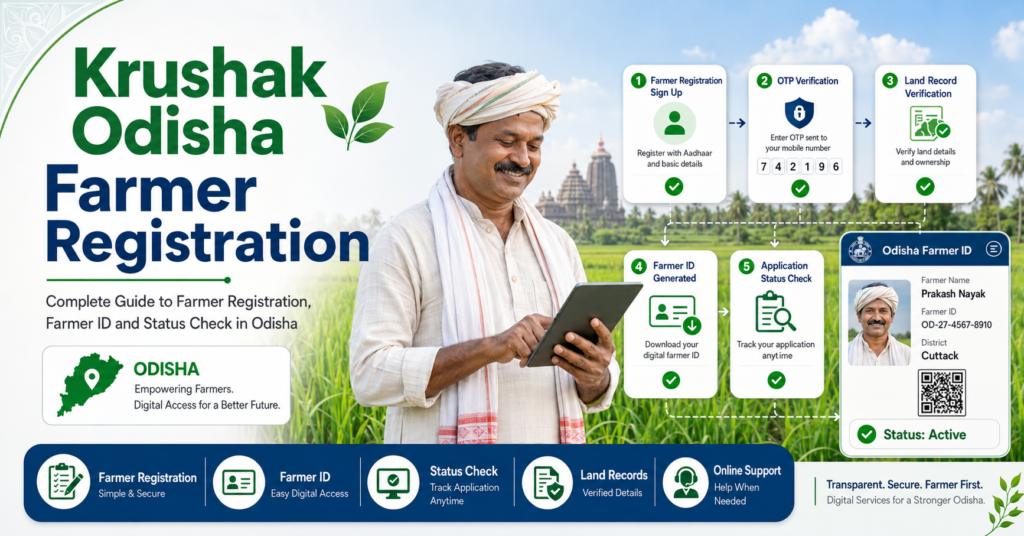
The national AgriStack picture sits on our overview page, and the generic application walkthrough on our farmer registration guide; this page keeps to Odisha’s own machinery.
State-wise official AgriStack farmer registry portals
Every button opens the official government website of that state. Registration is free on all of them.
| State | Official portal |
|---|---|
| Uttar PradeshUP Farmer Registry (UPFR) | Open UPFR Portal |
| MaharashtraMaharashtra Farmer Registry (MHFR) | Open MHFR Portal |
| Madhya PradeshMP Farmer Registry (MPFR) | Open MPFR Portal |
| GujaratGujarat Farmer Registry (GIFR) | Open GIFR Portal |
| RajasthanRajasthan Farmer Registry (RJFR) | Open RJFR Portal |
| BiharBihar Farmer Registry (BHFR) | Open BHFR Portal |
| OdishaKrushak Odisha | Open Krushak Odisha |
| TelanganaTelangana Farmer Registry | Open TGFR Portal |
| Andhra PradeshAP Farmer Registry (APFR) | Open APFR Portal |
| AssamAssam Farmer Registry | Open Assam Portal |
| KeralaAIMS Kerala | Open AIMS Kerala |
| Tamil NaduTN Farmer Registry (TNFR) | Open TNFR Portal |
| KarnatakaFRUITS Portal | Open FRUITS Portal |
| West BengalWB Farmer Registry (WBFR) | Open WBFR Portal |
| All other states & UTsNational AgriStack portal | Open AgriStack India |
What is Krushak Odisha?
Krushak Odisha is the state’s farmer database and portal, holding registered profiles of Odisha’s cultivators: landowning farmers verified against the Record of Rights (RoR), plus sharecroppers (bhag chasi) and agricultural households enrolled through KALIA’s ground-level verification years ago. Registration in this database is what Odisha means by farmer registration, and its alignment with AgriStack connects Odisha farmers to the national Farmer ID system that central schemes read.
The inherited breadth matters. KALIA’s design deliberately reached cultivators without land papers, so Odisha’s registry includes lakhs of sharecroppers invisible to registries elsewhere. If you cultivate another’s land in Odisha, you have a path into the system that your counterparts in most states still lack, and this page’s sharecropper section below covers it.
Registering on Krushak Odisha
What you need. Aadhaar with a working linked mobile (the OTP and fingerprint logic from our registration guide applies), your bank passbook, and for landowners the RoR details: khata and plot numbers, pulled current and free from Bhulekh Odisha by selecting district, tehsil and village. Sharecroppers gather their KALIA reference where one exists and local verification support instead of ownership papers.
Step 1: Open krushak.odisha.gov.in directly and use the registration or profile update route. Odisha has run mass enrollment and verification drives, so many farmers already hold profiles from the KALIA era; for them the task is updating and verifying the existing profile rather than creating a duplicate, and the portal’s search-by-Aadhaar tells you which case you are.
Step 2: Complete Aadhaar eKYC, confirm your identity details, and set up portal access with your mobile number.
Step 3: Landowners add khata and plot numbers; the system checks against the RoR and records your share in joint khatas, your name only, never the whole joint holding. Sharecroppers complete the declaration route with the village-level verification the state prescribes.
Step 4: Review, submit, and save the acknowledgement reference. Verification runs through agriculture field staff (the VAW network, village agricultural workers) and revenue checks for owned land, and approval brings your registry identity, aligned to the national Farmer ID, with the card and details available through the portal as our Farmer ID guide describes generally.
Common Service Centres and Mo Seba Kendras across Odisha handle assisted registration at the usual small notified fee, and block-level camps with VAWs and revenue staff together remain the best route for record-gap and inheritance cases.
Farmer ID list and status check in Odisha
Odisha publishes and surfaces farmer lists more visibly than most states, a KALIA-era habit that continues. Three checks Odisha farmers run:
Your individual status. On krushak.odisha.gov.in, search your profile by Aadhaar or acknowledgement reference to see your registration and verification state; the pending, approved and returned logic matches the national pattern in our status check guide.
The farmer ID list. Village-wise registered farmer lists are viewable through the portal’s reports, the route behind the constant “odisha farmer id list” searches. Finding your name with your ID confirms completion; absence after weeks says check your individual status.
Legacy agrisnetodisha lists. The older Agrisnet Odisha system (agrisnetodisha.ori.nic.in) carried farmer IDs and lists that many farmers still hold printouts of. Those legacy records fed the newer systems but are not the current registry; verify your standing on Krushak Odisha rather than relying on an old Agrisnet entry, the same legacy-portal caution we give UP farmers about upagriculture.
CM-Kisan: Odisha’s income support and its status check
Odisha’s income support now runs as CM-Kisan (the successor built on KALIA’s base), paying installments to registered small farmers and landless agricultural households, with the famous Nuakhai-timed releases. The beneficiary base reads the Krushak Odisha registry, which makes registration the gateway: an unverified profile is the usual story behind a missed installment.
Status checking runs on the CM-Kisan portal (cmkisan.odisha.gov.in), by Aadhaar, showing your beneficiary state and payment history. The fix-chain for stopped payments mirrors the PM-Kisan trio nationally: registry profile verified, eKYC complete, bank account Aadhaar-seeded, all three green before the next release. PM-Kisan’s central installments run alongside for eligible landowners, with the Farmer ID linking enforcement covered in our Farmer ID guide.
Food Odisha: paddy procurement, tokens and the registration behind them
For most Odisha farmers the registry’s cash value appears at paddy sale. Procurement runs through the Food Odisha ecosystem (the food odisha portal farmers search constantly): seasonal paddy registration, token issuance for mandi delivery, and payment tracking, with the state’s paddy price support making the stakes high every kharif.
The chain reads backward into everything above: your Food Odisha paddy registration checks your farmer registration, your recorded or declared cultivated area shapes your sellable quantity, and the crop survey entries feed the same calculation. Sharecroppers sell through their declared cultivation, which is exactly why their registry coverage matters. The season rule: registration verified and paddy registration done in the announced window, token in hand before you load the trailer, and a month’s margin over deadlines, since verification queues ignore mandi calendars.
Sharecroppers and landless households: Odisha’s wider door
Odisha’s registry is the country’s most generous to cultivators without land papers, and using that door correctly matters.
Sharecroppers (bhag chasi) register through declaration and village-level verification rather than RoR linkage, continuing the KALIA design. The declaration must reflect the real cultivation; verification is local, by people who know the fields. Landless agricultural households enrolled under KALIA’s livelihood component carry profiles in the same database, relevant to CM-Kisan’s landless-support stream.
Two cautions keep the door open. Sharecropper status does not create land rights, and the registry is not a tenancy claim; it is a benefits identity, and landowners lose nothing by their sharecroppers registering, a rumour that resurfaces every drive season. And a sharecropper should not attach an owner’s plot as owned land to strengthen a profile; the RoR check catches it and the clean declaration route was built precisely so nobody needs to.
Odisha schemes and systems reading the registry
Beyond CM-Kisan and paddy procurement: Samrudha Krushak Yojana style price support rides the procurement chain; crop insurance and calamity relief after cyclones and floods, Odisha’s recurring reality from coastal districts to the west, read the registry and crop entries, which is why post-cyclone relief now reaches accounts in weeks; input subsidies and mechanisation schemes through GO-SUGAM and the agriculture department identify applicants through the registry; and KCC drives use the database to reach eligible farmers, with banks reading verified profiles in place of paper chains.
Regional notes across Odisha
Coastal Odisha carries the paddy weight and the cyclone exposure, making crop entries and verified profiles the relief lifeline. Western Odisha (Sambalpur to Kalahandi) mixes heavy procurement volumes with migration, which parks Aadhaar-linked mobiles in other states and makes the fingerprint route at Mo Seba Kendras the practical fix. The KBK districts hold the largest sharecropper and landless coverage, KALIA’s original focus, where profile verification drives decide who the money reaches. Northern and tribal districts completed record digitisation last; missing villages and khata gaps route through the tehsil, and camps remain the productive path.
The Odisha portal map: every website explained
krushak.odisha.gov.in is the farmer database and registry: registration, profile verification, list and status checks.
cmkisan.odisha.gov.in runs the state income support: beneficiary status and payment history by Aadhaar.
The Food Odisha ecosystem handles paddy procurement: seasonal registration, tokens and payment tracking, the system where the registry converts into a mandi sale.
Bhulekh Odisha serves the land records: current RoR with khata and plot numbers, the pre-registration check for landowners and the post-mutation confirmation.
GO-SUGAM is the schemes window, where department applications identify farmers through the registry as alignment proceeds.
agrisnetodisha.ori.nic.in holds the legacy Agrisnet records and lists, history rather than the current registry.
pmkisan.gov.in carries the central installments for eligible landowners, with the Farmer ID linking, eKYC and seeding trio gating them nationally.
The Odisha working order: Bhulekh to verify the record (owners), Krushak Odisha to register or verify the profile, the crop entries confirmed each season, Food Odisha registration and token in the paddy window, CM-Kisan and pmkisan for the payment trails. Type addresses yourself; token seasons attract lookalike pages fishing for Aadhaar details.
Fixing Odisha-specific problems
Profile exists from KALIA but shows unverified. The commonest Odisha case: the old enrollment needs the current verification touch. Update and verify through the portal or a Mo Seba Kendra rather than creating a duplicate profile, which only freezes both.
RoR shows the late father. Complete the mutation through the tehsildar, confirm on Bhulekh Odisha, then update the profile; inheritance camps with revenue staff shorten the chain.
Name gap between Aadhaar and RoR. Odia record spellings versus Aadhaar transliterations follow the national pattern: small gaps pass, large ones need one side corrected, usually Aadhaar.
Paddy token refused despite registration. Check the season’s paddy registration separately from the base registry, confirm the cultivated-area calculation behind your token quantity, and raise mismatches at the block level before the mandi date.
CM-Kisan installment missed. Work the trio: profile verified on Krushak Odisha, eKYC done, bank Aadhaar-seeded, then the next release cycle picks you up.
Frequently asked questions: Krushak Odisha
What is krushak.odisha.gov.in?
It is Odisha’s official farmer database and portal, born from the KALIA scheme and now aligned with AgriStack, where Odisha farmers register, verify profiles, and check the farmer ID list and status. Registration is free.
Is Krushak Odisha registration the same as the national Farmer ID?
Odisha’s registry is the state’s implementation aligned with AgriStack, so your verified Krushak Odisha identity is how Odisha connects you to the national Farmer ID system that central schemes read. One verified profile serves both worlds.
How do I check the Odisha farmer ID list for my village?
Through the reports and list views on krushak.odisha.gov.in, selecting district, block and village. Your name with your ID in the list confirms completed registration; absence says check your individual status by Aadhaar.
Can sharecroppers register in Odisha?
Yes, uniquely well: Odisha’s KALIA-era design covers bhag chasi through declaration and village verification, no land papers needed. The declaration must reflect real cultivation, and registering creates a benefits identity, not a land right.
How do I check CM-Kisan status?
On cmkisan.odisha.gov.in by Aadhaar, showing beneficiary state and payment history. Missed installments almost always trace to an unverified registry profile, pending eKYC or unseeded bank account; fix all three before the next release.
What is the Food Odisha token and how does registration affect it?
The token authorises your paddy delivery at the mandi each season through the Food Odisha procurement system. It reads your farmer registration and cultivated area, so an unverified profile or missing seasonal paddy registration blocks the token however real your paddy is.
My old Agrisnet Odisha ID printout: is it still valid?
Treat it as legacy. Agrisnet-era records fed the newer systems but the current registry is Krushak Odisha; verify your standing there rather than relying on the old entry.
My RoR still shows my father who passed away. Can I register?
Complete the mutation through the tehsildar first, confirm on Bhulekh Odisha, then register or update your profile. Camps with revenue staff present walk heirs through both steps together.
Disclaimer: agristack.com.in/ is a private informational website with no connection to the Government of India or the Government of Odisha. Registration happens only on official gov.in portals. Confirm current rules on krushak.odisha.gov.in or at your local agriculture office before acting.