What Is Farmer ID? Meaning, Full Form, Benefits and Who Needs It
Ask ten people at a tehsil what the Farmer ID actually is and you will hear ten answers: a card, a scheme, a new tax record, a PM-Kisan number. None quite right. This post settles the meaning in plain words: what the Farmer ID is, what the letters and digits stand for, who needs one, what it costs, and what it is not.
Farmer ID meaning in one paragraph
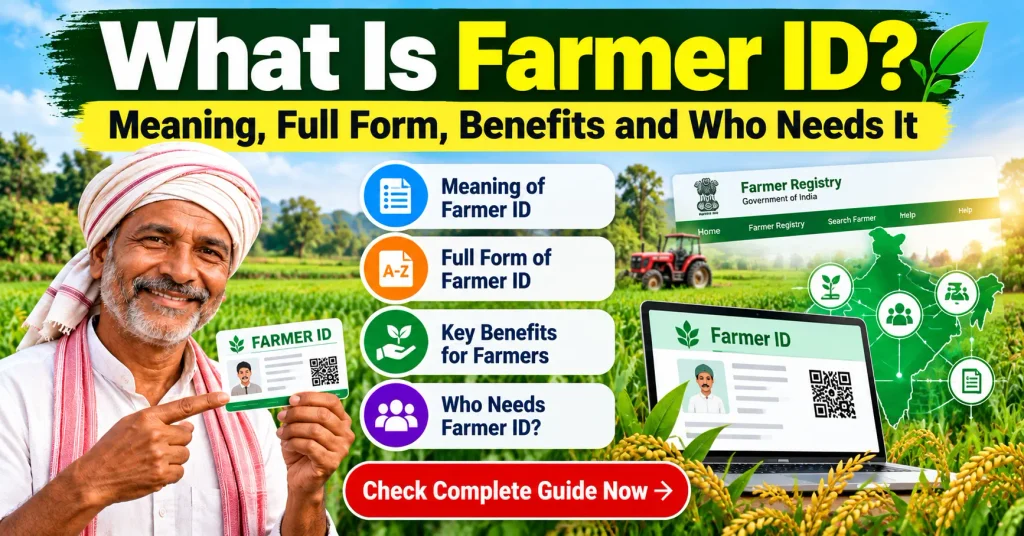
The Farmer ID is an 11-digit number the government gives a farmer after verifying two things: who you are (through Aadhaar) and what land you cultivate (through the state land record). It is issued from the Farmers Registry, the core database of AgriStack, and it works as your permanent identity for everything agricultural: PM-Kisan installments, crop loans, MSP procurement, insurance, subsidies and relief. One farmer, one number, for life.
People also call it the kisan ID, FID or Farmer Registry ID; all the same number. Some hear “TRFR” and similar short forms from state registry names (the pattern is the state code plus FR, so UPFR is the UP Farmer Registry, MPFR is MP’s, and a term like TGFR points to Telangana’s); those name the state registries, and the ID they issue is this same 11-digit number.
The quick facts
| Question | Answer |
|---|---|
| How many digits | 11, issued once, valid for life |
| Who issues it | Your state’s Farmer Registry under AgriStack, after Aadhaar and land verification |
| What it costs | Nothing; only a small CSC service fee if an operator assists you |
| Renewal or expiry | None, ever; the record behind it updates, the number never changes |
| Where it is used | PM-Kisan, KCC and crop loans, MSP procurement, insurance, subsidies, relief |
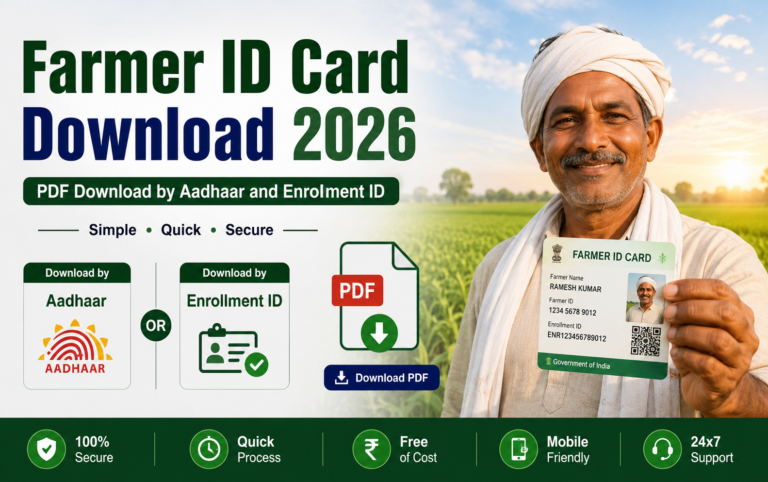
| Physical form | A free downloadable PDF card with your photo and a QR code |
Who needs a Farmer ID
Every cultivator whose name stands in a land record should hold one, and in practice the schemes have removed the choice: PM-Kisan is enforcing it, procurement systems read it, banks prefer it. Three groups deserve a specific word.
Women whose names are on the record should register their own IDs rather than staying inside a husband’s or father’s registration; each recorded holder gets individual scheme standing.
Every co-owner in joint family land registers separately against their own share. One brother’s ID does not cover the family.
Tenant farmers and sharecroppers are covered only where their state has opened that route; Odisha leads here, and most states still verify through ownership records. If you cultivate without owning, ask your krishi sahayak what your state currently accepts.
Landless agricultural labourers sit outside the registry in most states for now, since the system is built around cultivated land.
What the Farmer ID is not
Half the confusion around the ID comes from lookalike numbers, so here is the clearing-up.
It is not the Kisan Credit Card, which is a bank loan product. It is not your PM-Kisan registration number, which is a scheme reference that itself now wants your Farmer ID. It is not Bhu Aadhaar (ULPIN), the 14-digit number that identifies a land plot rather than a person. And it is not any of the old state registrations, UP’s kisan panjikaran or Bihar’s 13-digit DBT number, none of which convert into it. The full comparison of every number a farmer juggles sits in our Farmer ID guide.
It is also not a land document. The ID reads your land record; it cannot change ownership, create tax, or be used to acquire anything. That rumour has kept lakhs of eligible farmers out of their own benefits.
How you get one: the short version
Registration happens on your state’s registry portal or through a CSC centre or village camp: Aadhaar eKYC, a short form, your land parcels added by their record numbers, and verification by agriculture and revenue officials. The ID arrives by SMS on approval, usually within days to a few weeks, and the card downloads free from your dashboard. The complete screen-by-screen process, including joint land, inherited land and every rejection fix, lives in our farmer registration guide, and the state-wise portal details start from our AgriStack overview.
Frequently asked questions
What is the full form of Farmer ID?
There is no expansion of “Farmer ID” itself; it simply means the farmer’s identity number. The related full forms: FID is Farmer ID, and the state registry names expand as the state plus Farmer Registry, like UPFR for Uttar Pradesh Farmer Registry.
What does farmer kya hota hai mean in this context?
Searches like farmer ID kya hota hai ask exactly what this post answers: it is the government’s 11-digit pehchan number for a kisan, linked to Aadhaar and land, needed for PM-Kisan, loans, mandi sale and subsidies. Registration is free at the state portal or any CSC.
Is the Farmer ID the same as the farmer ID card?
The ID is the number in the registry; the card is the free PDF carrying that number with your photo and a QR code. Losing the card means printing again; the number itself never changes and never expires.
How many digits is a Farmer ID?
Eleven. A 12-digit number is Aadhaar, 14 digits is ULPIN for a plot, 13 digits was Bihar’s old DBT number, and bank-format numbers belong to the KCC. When an office asks for your farmer number, the 11-digit one is almost always what they mean.
Does it cost anything to get or keep?
Nothing, ever. Registration is free, the card is free, there is no renewal and no yearly fee. The only legitimate payment anywhere near the process is a CSC’s small notified service charge for assisted registration.